
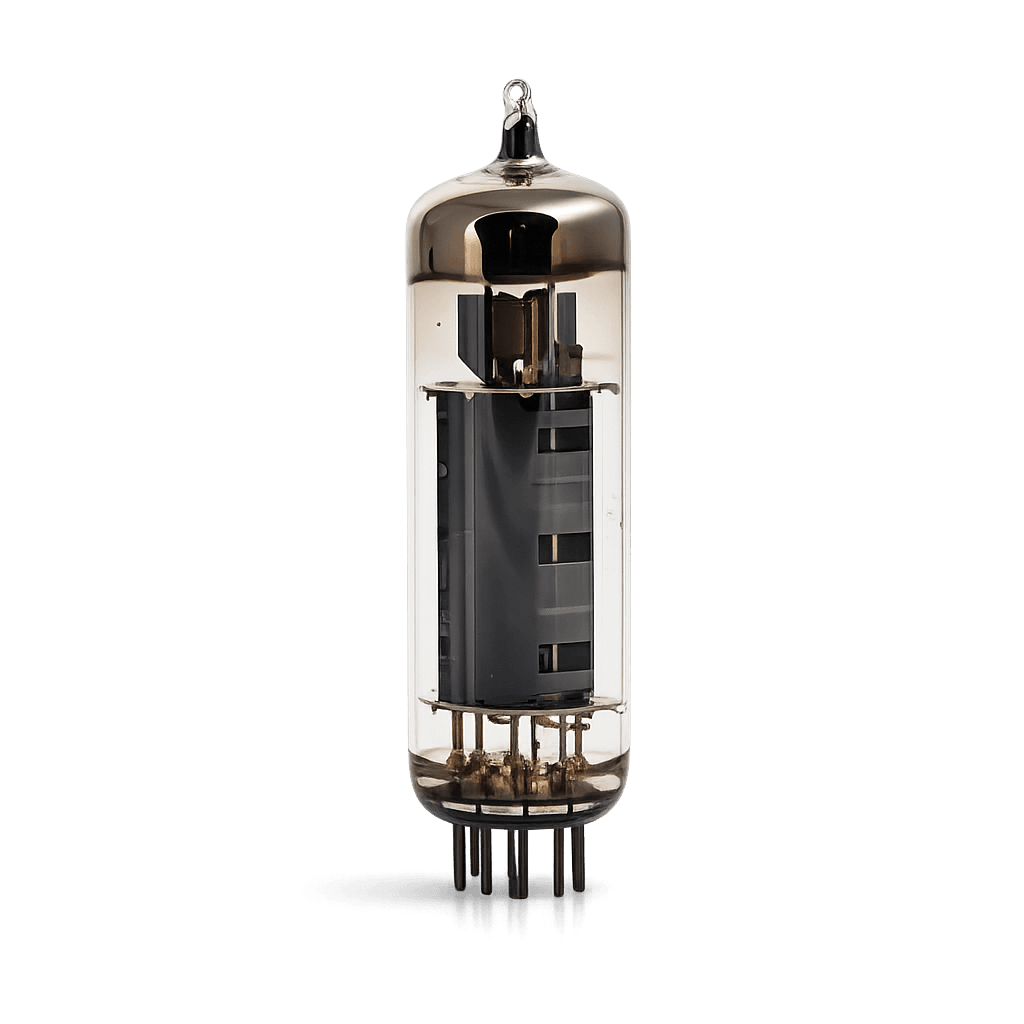
How Long Do Vacuum Tubes Last? Signs It’s Time for a Replacement
Tube service life varies with type, circuit and use. Learn which symptoms warrant testing and why amplifier faults can mimic a worn tube.
Glass Audio Team7 October 2026
Power tubes operate in an amplifier’s output stage. Their type affects the electrical requirements of the circuit, but the tube label alone does not determine compatibility or a guaranteed listening result.
The EL34 is an output pentode commonly used in audio amplifiers. It has an octal base, but a shared base does not make it interchangeable with other octal power tubes. Check the amplifier maker’s specified type, pin connections, heater supply, anode and screen limits, dissipation, and bias requirements.
6L6-family types include variants with different ratings. A 5881 is related to the 6L6 family, but it is not a universal drop-in replacement for every 6L6 or 6L6GC. Compare the exact manufacturer datasheets with the amplifier’s operating conditions before substituting.
The KT88 is a beam power output tube. Its physical base format does not establish that an amplifier designed for EL34 or 6L6-family tubes can safely use it. The power supply, output stage, heater supply, screen circuit, bias range and transformer limits all matter.
Use the exact tube type specified in the amplifier manual or service documentation. When considering a substitute, have a qualified technician compare pin connections, heater current, maximum anode and screen ratings, dissipation, bias requirements and the amplifier’s actual operating point. Fixed-bias amplifiers generally need the bias checked after power-tube replacement. Cathode bias does not guarantee that every substitute is suitable.
Valve amplifiers can retain dangerous voltages after they are switched off and unplugged. Do not open or adjust a live amplifier unless qualified to work safely around high voltage. If the correct tube type or bias procedure is unclear, consult the amplifier manufacturer or a qualified technician.
Tube service life varies with type, circuit and use. Learn which symptoms warrant testing and why amplifier faults can mimic a worn tube.
Learn what power-tube bias does, how fixed-bias and cathode-bias designs differ, and why adjustment should follow the amplifier maker’s instructions.
Learn what NOS and reissue mean, what to verify about condition and testing, and why compatibility depends on the exact tube and amplifier.